When 46% of invited patients won't take a free benefit
Lifting sign-up from 54% to 59.3% on a polygenic risk score service.
- 5.3% lift in sign-up from 54% to 59.3%
- 40+ points above the healthcare conversion benchmark
Context
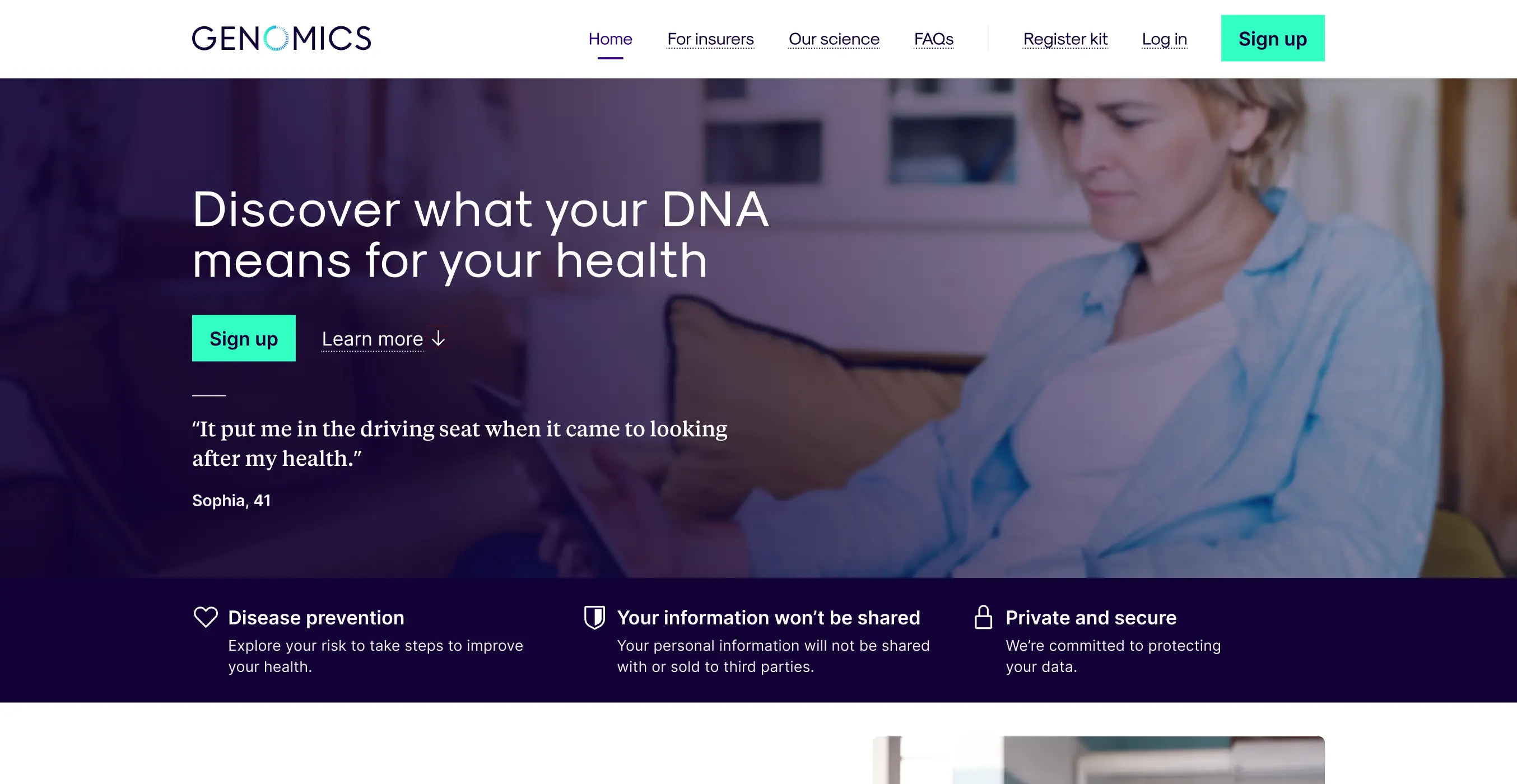
A Series B healthtech scale-up offering polygenic risk score testing through US insurers. 3,000 policyholders of a US insurance partner had been invited to take a free genetic test as part of their cover. 54% signed up. The other 46% bounced. The scale-up needed conversion proof to secure the next phase of the partnership and to attract other insurers. As sole product designer, I led the marketing site redesign end-to-end and partnered with the Lead Product Designer on the polygenic risk visualisation.
The problem
- 3,000 policyholders received an invite to a free genetic test through their life insurance partner. 54% signed up.
- Surveys showed the other 46% couldn't see who was behind the test, what they'd get, or whether 'free' had a catch. A scale-up that depended on partnership renewals couldn't grow on those numbers.
What made it hard
- Patients distrusted a free offer. They worried about data, hidden costs, and the people behind the test.
- The fix had to satisfy legal review, scientific accuracy, and a buyer aged 35 to 70 with no genetics background.
- Conventional CRO patterns don't translate to regulated health products.
How I helped
-
Treated this as a trust problem, not a copy problem
Most conversion work goes after headlines, CTAs, and form length. The survey data pointed in a different direction. Patients didn't doubt the offer. They doubted the company. They worried about who saw their DNA, where the data went, and what "free" meant.
I pushed the team to commit to a product name so trust signals had something to attach to. Without product identity, the trust content would sit on a generic corporate shell. The name went through patient research before we built around it.
I reframed the brief. From "lift sign-up" to "earn trust on the first read." That changed which pages we rebuilt and in what order.
Why this mattered: A copy-led approach would have stalled. The lift sat in trust signals, not button colour.
-
Made the science a sales asset, not a hurdle
The original Science page used language built for researchers. Patients bounced. I worked with the science and medical teams to rewrite it for a 35 to 70-year-old reader with no genetics background, keeping the medical leads happy on accuracy.
Three moves did the work:
- A How it works page, lifted from a buried home section into top navigation. It explained how DNA gets analysed and what patients could do with results.
- An accuracy comparison chart using AUC data from third-party benchmarks and internal sources. Research showed perceived accuracy as the top factor patients used to pick between tests.
- Expanded bios for medical and executive staff with where they studied, why they joined, and what they had published. This came from a usability test quote: "I want to know more about the doctors."
Why this mattered: The Science page drove 3.2% of all sign-ups. Trust content earned its place.
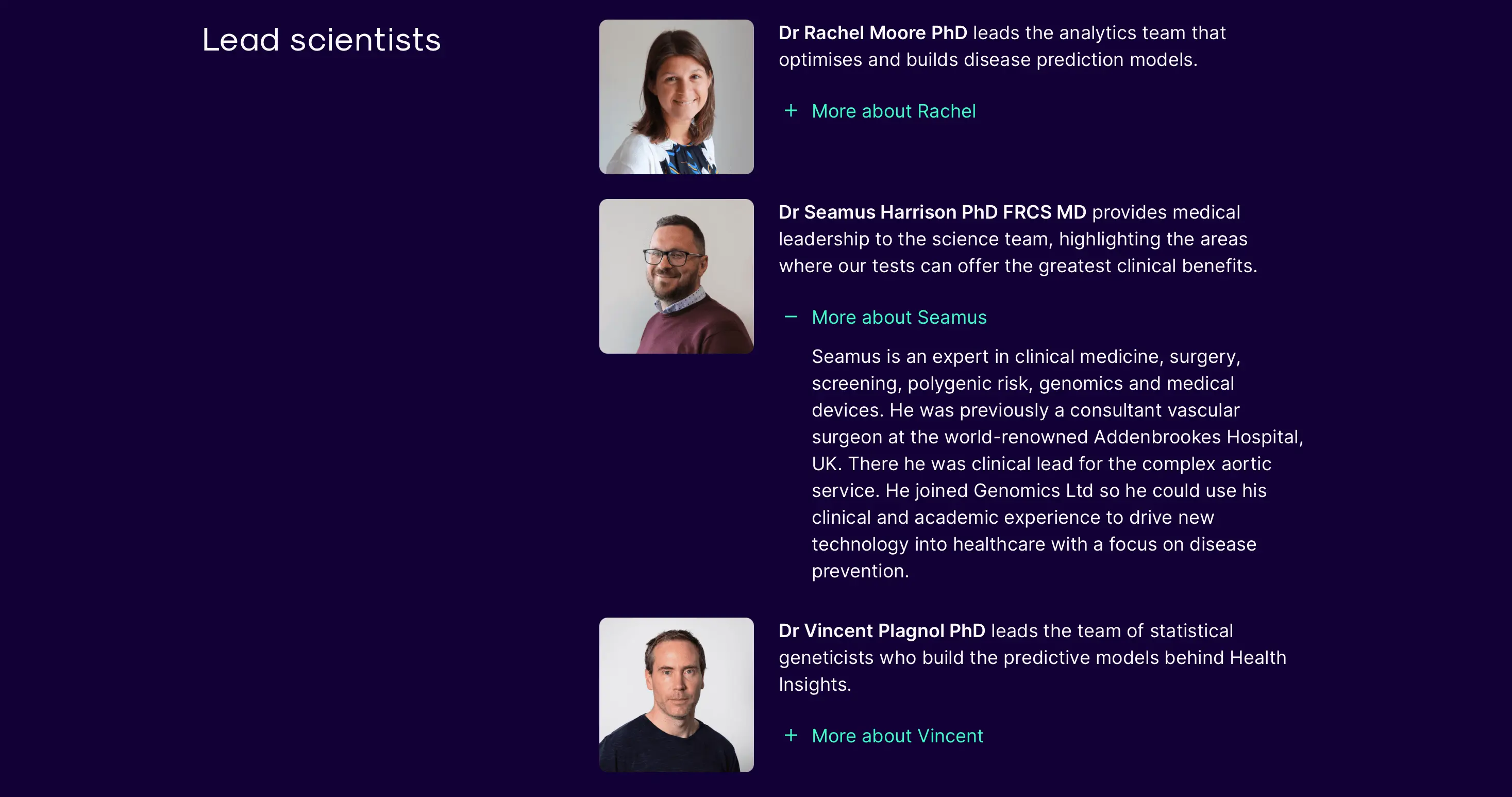
Custom illustrations of the medical and executive team on the Science page.
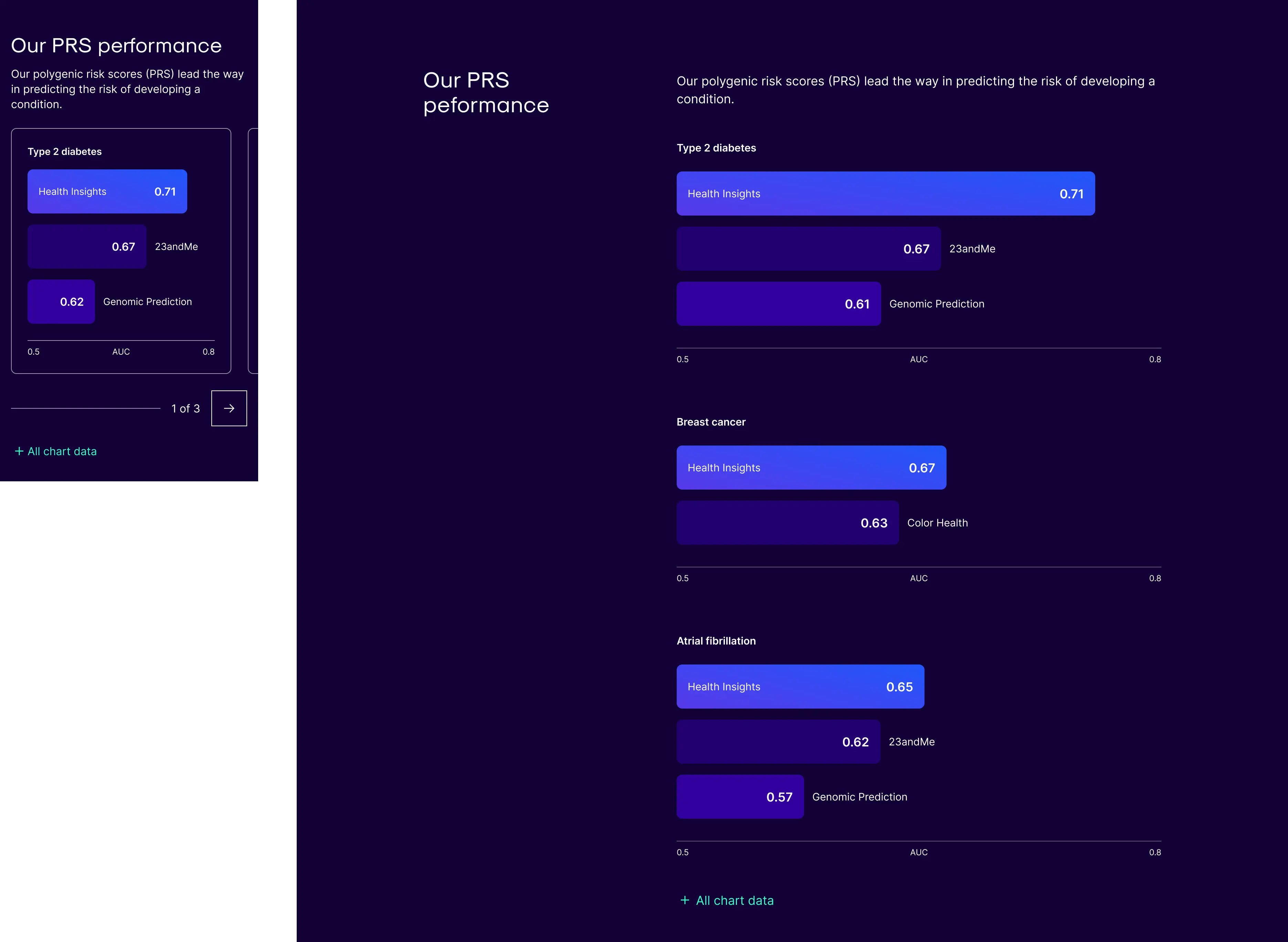
Accuracy comparison chart concept using third-party AUC data alongside internal sources.
-
Showed the deliverable without confusing it
The original hero featured a sample report. It looked logical. Test five users and three got confused. The report raised questions it should have answered.
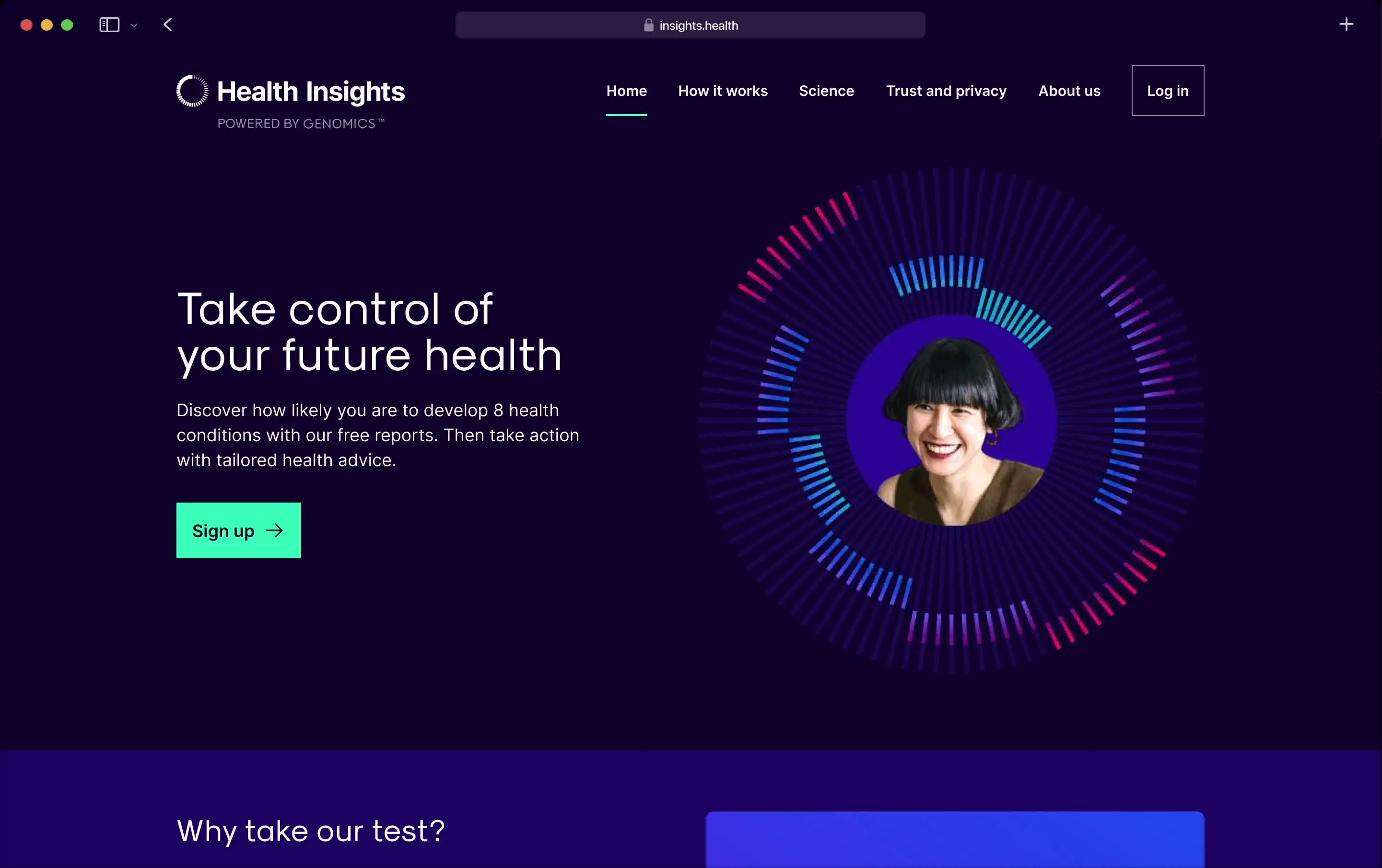
I looked for ways to show the test without showing the report. The Lead Product Designer had a circular motif in early concept work. I adopted it, animated it with avatars to show how results vary between individuals, and used it to convey the polygenic nature of the test in one image.
The judgement call: Killing a hero asset that looked strong on paper. The sample report had been a stakeholder favourite. The test data made the case for replacing it.

Animated circular motif replacing the sample report in the hero, showing how polygenic risk varies between individuals.
-
Held the line when the market shifted
A major direct-to-consumer genetic testing company announced a data breach. A live threat sat in front of us: a competitor losing customer data while we tried to drive sign-ups for a genetic test. I ran a 50-person pulse survey in the target demographic, explained the breach, and tested a prototype.
The survey showed:
- 18% awareness of the breach (9 of 50 patients)
- 70% said data security mattered "a great deal" to them
- 60% said they would trust the platform with their genetic data
- Of the 9 aware of the breach, 5 said they would trust the platform
I held the site as designed. A reactive redesign without evidence would have signalled panic to patients who hadn't heard about the breach.
What this shows about working with me: When the market shifts, I check the data before I redesign. That keeps engineering off a treadmill.
-
His blend of technical skill, principled user-centred thinking, and experience make him a valuable addition to the team.
 Tom Byers, Genomics
What changed
- 159 additional sign-ups across the cohort of 3,000.
- The Science page drove 3.2% of all sign-ups (57 patients).
- Sign-up intent doubled between the two usability tests.
Where this led
The platform secured further investment to expand the polygenic risk score offering. The US partnership grew to cover additional policyholders. A major UK insurer praised the visual identity and joined the platform, launching the UK's first polygenic risk score test. The product secured a research collaboration with a major pharmaceutical partner.
Sound familiar? Get an audit of an underperforming flow in your health product.
- Report on one flow with found issues
- 3-5 prioritised fix recommendations
- 45-minute video call to walk through findings
- Fixes found or money back
£2500 + VAT. Delivered in 5 working days via email.