
I walked Healthera's Mounjaro and Wegovy flows this week. The clinical model underneath is the strongest in UK private weight loss. The flow on top of it sells like every anonymous internet pharmacy it sits beside.
The UK prescription weight-loss market reached around £335 million in 2025 and is projected to hit £405 million in 2026, and four in five UK weight-loss users are on Mounjaro. Numan, Voy, Manual, Boots and Healthera chase the same patient. Most compete on price and speed. Healthera has something structural, and leaves it off the screen.
The advantage no rival can copy
Healthera runs its prescriptions through 1,700 community pharmacies. Each is a real building with a real pharmacist on the GPhC register, reviewing the questionnaire before a prescription is approved. Numan, Voy and Boots cannot replicate a decade-old pharmacy network. You can't ship it in a sprint.
It pays off twice. Commercially, it gives Healthera a clinical story no purely online prescriber can tell. For risk, it makes Healthera the best-placed UK provider as the MHRA moves on online weight-loss prescribing.
An advantage only counts when the patient sees it. Across the Mounjaro flow, it stays hidden in the four moments that need it most.
Four trust moments the flow leaks
The anonymous clinician
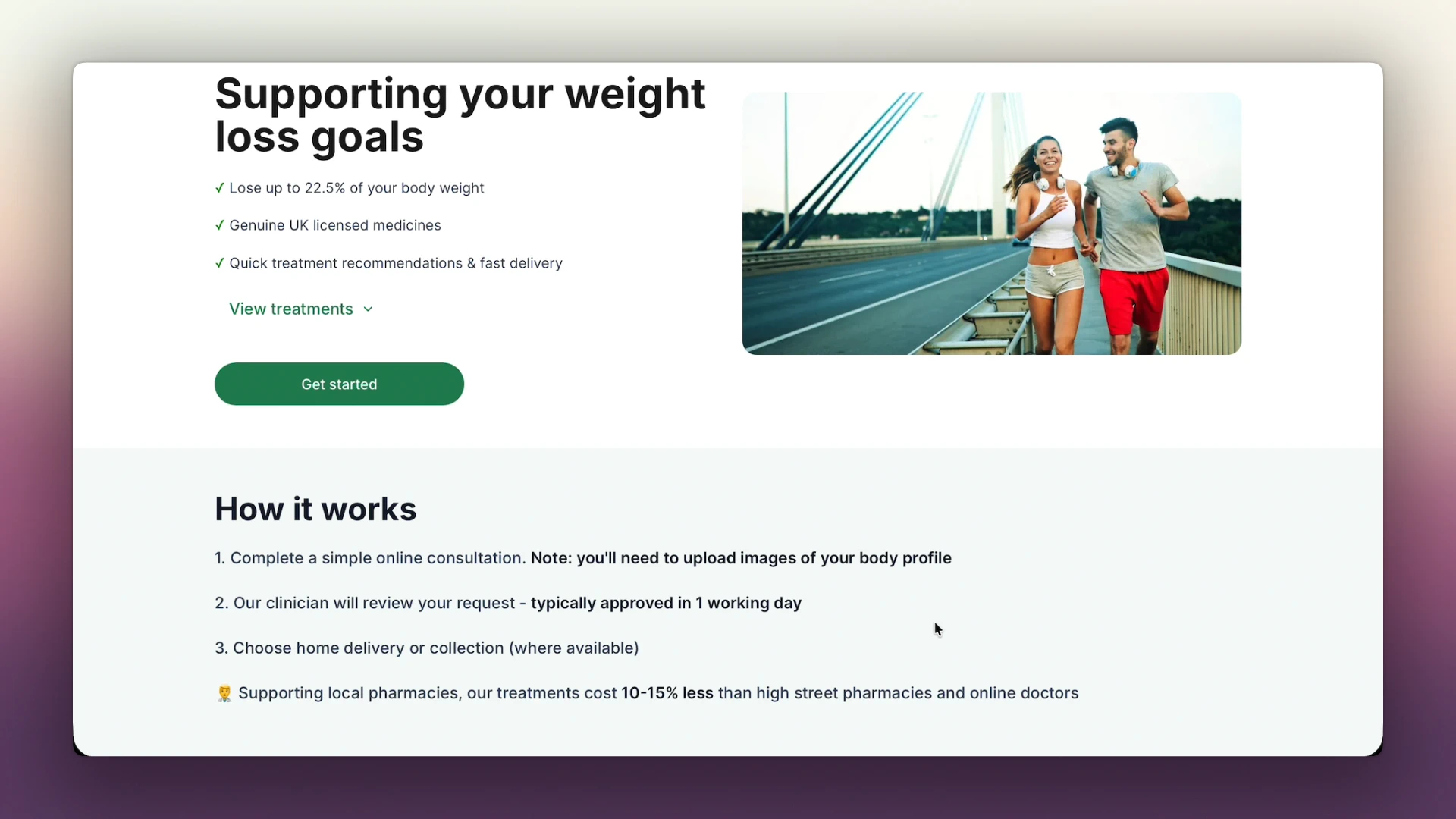
The questionnaire says: 'Our clinician will approve your request.' It reads as reassurance until the patient's real question lands. Which clinician? Can I see them? A named pharmacist, or a remote signer?
Healthera's whole differentiation is the named human in a real building, and the copy reads like Numan's. Fix it where it bites: name the pharmacist who will review the request, show their GPhC registration, show their pharmacy. The review that reads as a hurdle is the reason to trust the service.
The 22.5% claim with no safety frame
The marketing page promises 'up to 22.5% of bodyweight.' The figure is real, from the SURMOUNT-1 tirzepatide trial. The context is missing. Trial participants get structured support, weekly check-ins and free medication. Most patients won't, and real-world results sit below trial results. A January 2026 review of 9,341 adults found weight returns four times faster after stopping these injections than after diet and exercise.
A healthy target of 10 to 15%, framed for safety, would do more work than the bigger number. It tells the patient you are treating them as someone to keep safe. That message has to come from the brand whose edge is clinical care.
The unexplained price
The page claims treatments cost '10 to 15% less than high-street pharmacies and online doctors,' and gives no reason. Cheaper because the network is efficient? Because margins are thin? Because quality is lower? The patient fills the gap with the least flattering answer.
The fix is the clinician fix again. Healthera is cheaper because 1,700 pharmacies carry scale a single online clinic cannot match. Tell that, and the price becomes proof of the advantage.
The data-handling silence
The questionnaire collects weight, BMI, medical history and current medications, and says nothing about what happens to any of it. Where it is stored, for how long, who sees it. For a wellness checkout, perhaps acceptable. For a pharmacist-led clinical service, the silence undercuts the trust the model runs on. A short, plain-English data note at the top, the same UK GDPR and NHS principles the pharmacy partners already follow, costs little and matches the clinical promise.
What the gap costs, and why the regulator makes it urgent
Long clinical questionnaires shed people at every unexplained step. Healthera's Mounjaro form runs four such steps at once, in a market heading past £400 million, at a volume where a few points of completion is real money. I won't invent a precise figure for someone else's funnel. The pattern is the point: four compounding trust gaps on the highest-intent screen in the journey. It is the same pattern across health onboarding, where most sign-up drop-off is a trust problem.
The regulator makes fixing them urgent. In September 2025 the MHRA forced six UK weight-loss companies, Voy and MedExpress among them, to amend adverts that promoted prescription-only medicines to the public. The same year it seized over 5,000 illegal GLP-1 doses inside a £45 million crackdown, and Australia's regulator has taken the same line on weight-loss advertising. Identity, safety framing and informed consent used to be UX preferences. In 2026 they are risk controls, and Healthera's pharmacy-led model is the category's strongest regulatory defence. The flow barely shows it.
Three lessons for any UK private health flow
- Your structural advantage has to be visible in the flow that uses it. A pharmacy network, a medical director, an NHS partnership: none of it counts if the patient never meets the proof.
- In a regulated category, trust copy lifts completion for less than a redesign costs. Explaining why you ask a question, where the data goes and who reviews the result earns more completion than a new button colour.
- The flows that age well earn trust at the right moments. Identity, safety framing and consent are commercial and regulatory necessities at once now.
This walkthrough is some of the work I do as a flow UX audit: five working days, one flow, the exact moments it loses people and the fixes ranked by what they earn. I ran the same playbook on a genomics sign-up and pushed conversion past the healthcare benchmark. If your own flow leaks revenue and the analytics won't say where, that is the gap an audit closes.
